
Products
Smart Access
- RFID
- RFID Cards
- RFID Wristbands
- RFID Key Fobs
- Access Readers & Terminals
- Full-Height Turnstiles
- Tripod Turnstiles
- Security Interlocks
- Swing Gates
- Full-Height Turnstiles
- Electronic Locking Systems
- Locker Locks
Professional RFID
- RFID
- RFID Readers / Antennas
- RFID Embedded
- Mobile Data Collection
- RFID PDAs
- RFID Tablets
- RFID Scanners
Wireless IoT
- Outdoor Solutions
- Asset Tracker
- Temperature Tracker
- Animal Tracker
- Vehicle Tracker
- Indoor Solutions
- Indoor Tracker
- People Tracker
- Software Solutions
- IoT Platform
Applications
Smart Access
Professional RFID
Wireless IoT
Company
Professional RFID
RFID explained: How automatic identification works
Date:
28.08.2026
Reading time:
5 min
Author:

Inhaltsverzeichnis
We encounter RFID in our daily lives and in business more often than it might seem at first glance: when opening a door contactlessly, in production, or when tracking goods. But what exactly is RFID and how does the technology work?
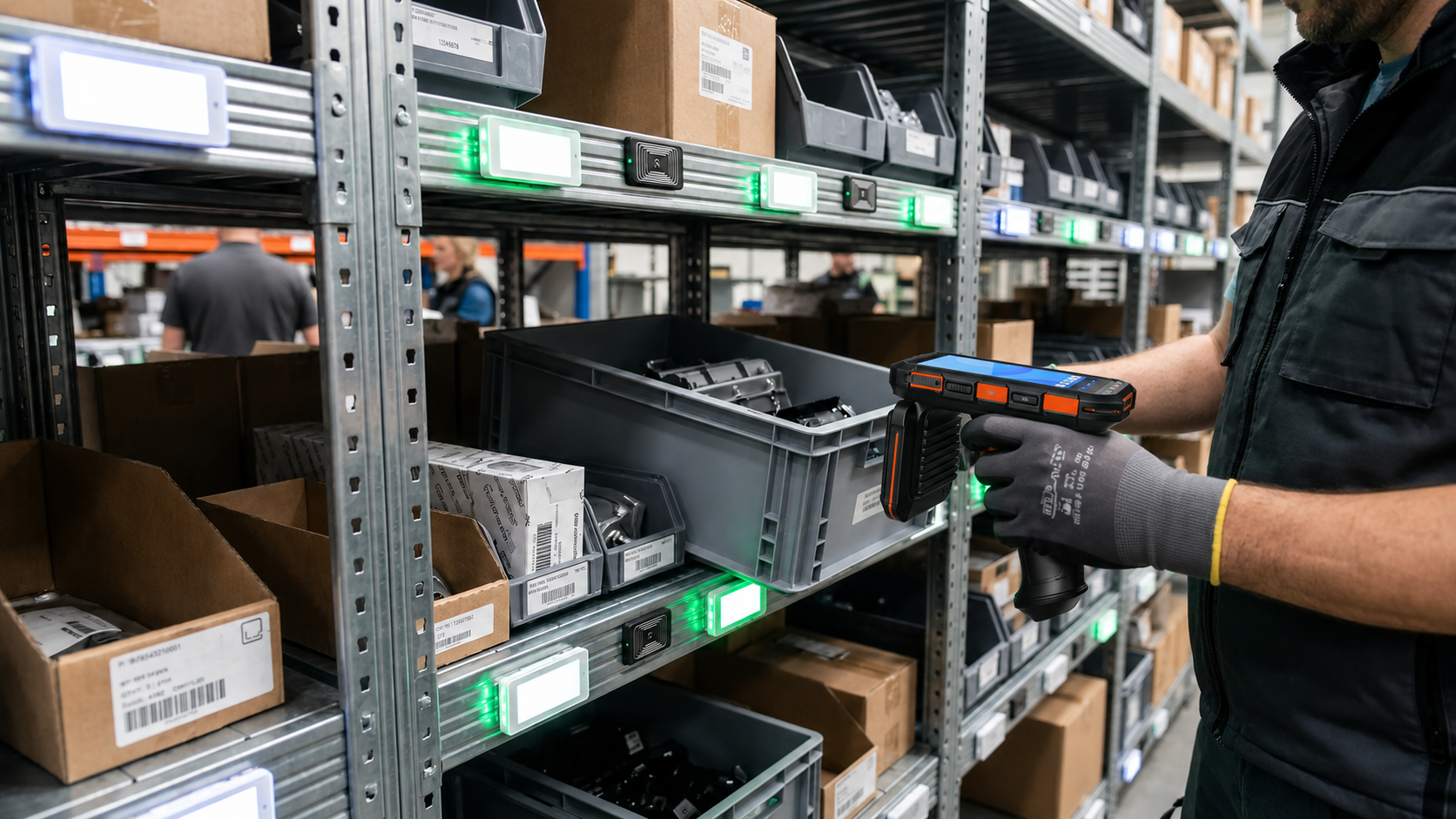
RFID stands for "Radio Frequency Identification," which means identification via radio waves. RFID technology allows objects, equipment, and people to be identified contactlessly. The required data is transmitted between an RFID transponder and an RFID reader. As a result, an RFID system can automate many manual scanning and documentation processes.
How does RFID work?
The way RFID works is based on three central components:
- an RFID tag with an RFID chip and antenna
- a RFID reader with one or more antennas
- software for processing the captured data
The reader generates an electromagnetic field via its antenna. If a suitable RFID transponder is within range, its antenna receives the signals. The RFID chip processes the request and transmits stored information, such as a unique identification number.
The RFID reader receives the returned signals and forwards the data to software, machine controls, or a higher-level ERP, WMS, or MES system. In this way, simple identification becomes an automated digital process.
Depending on the RFID system, not only individual RFID tags but many RFID transponders can be detected simultaneously. Direct line-of-sight, as required for barcodes, is not necessary.
What is an RFID tag?
An RFID tag – also known as an RFID transponder – essentially consists of an RFID chip and an antenna. Information is stored on the chip, which the reader can access contactlessly. Depending on the design, the data can also be updated or overwritten.
RFID tags are available in numerous designs. These include self-adhesive labels, robust industrial tags, on-metal transponders, RFID cards, wristbands or key fobs. The appropriate version depends on factors such as the material of the object, the environment, the required range, and mechanical stress.
For industrial use, RFID tags can be protected against moisture, dirt, chemicals, high temperatures, or mechanical stress, for example. Mounting on metal also requires specially adapted RFID transponders. To find the right RFID transponder, you can use our RFID tag finder .
Passive and active RFID tags
Passive RFID tags do not have their own power supply. They draw their energy from the signals of the RFID reader. This solution is compact, durable, and relatively cost-effective. Passive RFID tags are therefore frequently used in logistics, production, and access control.
Active RFID tags on the other hand, are equipped with a battery. They can transmit signals over longer distances and integrate additional sensors. Active RFID is suitable, for example, for tracking vehicles, load carriers, or valuable assets across large industrial sites.
Semi-passive RFID tags fall between these two variants. Their battery powers the RFID chip or connected sensors, while communication is still initiated by the reader.
What RFID frequencies are available?
The RFID frequencies used influence range, data transmission, and performance in the presence of different materials. The most important frequency ranges include:
LF – Low Frequency
LF typically operates at 125 or 134.2 kHz. The range is short, but the wireless technology is comparatively reliable near liquids and interfering materials. Typical applications include animal identification and specialized industrial solutions.
HF and NFC
HF RFID operates at 13.56 MHz. Depending on the antenna, transponder, and environment, the range is usually from a few centimeters to about one meter. HF RFID is used in applications such as RFID cards, access control systems, libraries, and production control.
NFC is also based on 13.56 MHz and is a subset of HF technology. When comparing "NFC vs. RFID," it is important to note that NFC is a specialized form of RFID communication with a short range and standardized data exchange. Many smartphones support NFC, but not necessarily other RFID frequencies.
UHF RFID
UHF typically operates in Europe in the range of 865 to 868 MHz. UHF RFID enables a range of several meters and can scan numerous RFID tags in a short amount of time. This makes the technology particularly attractive for logistics, inventory management, goods receipt, and production.
The optimal frequency cannot be selected based on maximum range alone. Materials, installation conditions, the number of RFID tags, the speed of the objects, and existing sources of interference must also be taken into account.
Typical RFID applications in companies
The potential areas of application for RFID range from simple identification tasks to fully automated processes. Typical RFID applications include:
- automatic identification of workpieces and tools
- recording of goods during incoming and outgoing goods processes
- inventory management and stocktaking
- tracking of containers, pallets, and load carriers
- machine control based on identified components
- access control using RFID cards or transponders
- documentation of maintenance and production data
- asset tracking of mobile resources
In production, an RFID system can, for example, detect which workpiece is reaching a station. The machine control then automatically loads the appropriate parameters. In logistics, multiple tagged resources can be recorded as they pass through an RFID gate. This reduces manual input and improves data quality.
Pros and cons of RFID
Key advantages of RFID technology include contactless identification, automatic data collection, and the ability to read multiple RFID tags simultaneously. Depending on the design, RFID chips can be rewritten and integrated into rugged housings. This gives companies greater transparency regarding inventory, assets, and process steps.
However, RFID also has potential drawbacks. Costs are often higher than those of simple barcodes. Metal, liquids, or poorly positioned antennas can interfere with signals and thus affect the read range. Furthermore, data protection, access rights, and IT security must be considered during the initial design phase.
Therefore, the key is not just selecting individual RFID readers or transponders. A reliable RFID system is created by carefully coordinating the RFID chip, antennas, frequencies, interfaces, software, and installation environment.
Conclusion: RFID as the foundation for automated processes
Simply put, RFID means: An RFID reader communicates wirelessly with an RFID tag and transmits its data to a digital system. This allows the technology to provide fast, automatic identification—without direct line-of-sight and, depending on the application, over a distance of several meters.
For successful integration, companies should first analyze their processes in detail and then design the RFID system accordingly. iDTRONIC supports companies, system integrators, and OEMs in selecting suitable RFID tags, readers, and antennas, as well as with technical integration. SDKs, versatile interfaces, and project-specific hardware solutions make it easy to incorporate these into existing systems.
Frequently asked questions about RFID
What is RFID?
RFID is a wireless technology used for the contactless identification of objects or people. An RFID transponder transmits stored information to a reader.
What is the range of an RFID system?
The range depends on the frequency, transmission power, antennas, RFID tag, and environment. It can range from a few centimeters for LF, HF, and NFC to several meters for UHF.
What is the difference between RFID and NFC?
NFC is a specialized HF RFID technology for short distances. RFID also encompasses other frequencies and, depending on the system, allows for significantly greater ranges as well as the simultaneous identification of many transponders.
Which RFID solution is suitable for industrial applications?
That depends on the process. UHF is often suitable for logistics and inventory management, while HF and NFC are used for short, controlled reading distances. Materials, mounting, environmental conditions, and required interfaces also influence the selection.
Sources
- RFID Journal
- Federal Office for Information Security – RFID
- AIM Global – RFID Resources
- Fraunhofer Institute for Integrated Circuits IIS

Contact us
We are happy to provide personal advice on choosing the right solution.
Your contact person:
Personalized consultation for your RFID project
Benjamin Pfeiffer

Personal consultation for your RFID project
Andreas Jäger - Sales Director

Personal consultation for your IoT project
Luca Mack - Sales IoT