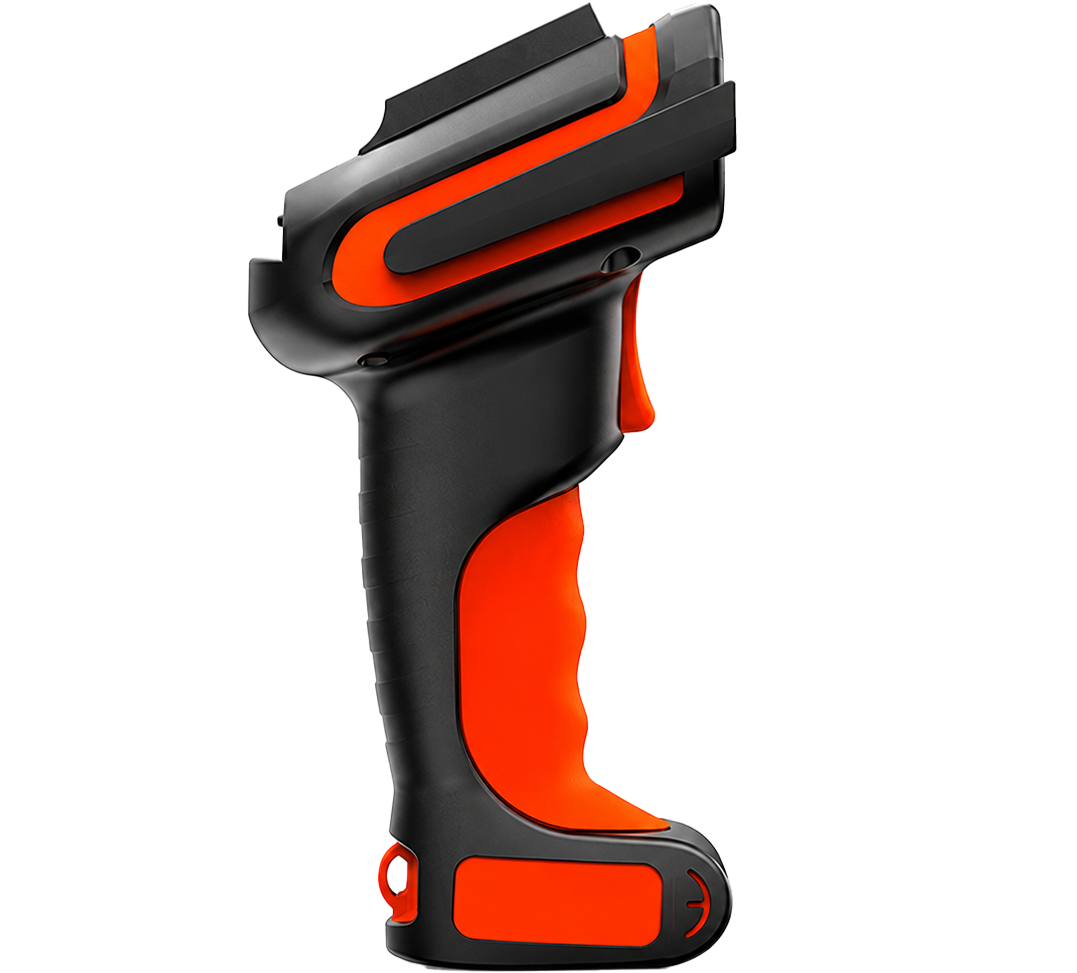
RFID Scanner
RFID scanners are handy devices for quickly reading transponders, barcodes, and 2D codes. Data is captured directly on-site and transmitted immediately, with no detours. The compact design fits in any hand, making it a reliable companion for daily tasks in warehousing, logistics, and field service.

Nicht sicher, welcher RFID Scanner passt?
We provide personalized advice to help you choose the right RFID scanner.
An RFID scanner is a mobile RFID reader used for the contactless identification of objects and for reading RFID tags. The device captures the data stored on an RFID transponder and transmits it to a computer, mobile device, or software application. Mobile RFID scanners often combine RFID technology with barcode and 2D code scanning. This allows different labeling systems to be processed with a single compact device.
An RFID scanner generates an electromagnetic field via its antenna. When a compatible RFID transponder is within range, it communicates contactlessly with the RFID reader. The RFID reader retrieves the stored information and transmits the data to the connected system via USB, Bluetooth, or Wi-Fi, for example.
Depending on the RFID technology, individual tags can be scanned specifically, or multiple RFID tags can be captured in a short amount of time. Some RFID readers support writing to compatible transponders in addition to reading them, which is why they are referred to as RFID read/write devices.
The terms RFID scanner and RFID reader are often used interchangeably. Both devices are used for the contactless detection and identification of RFID transponders. In practice, the term RFID scanner is frequently used for mobile, handheld devices, whereas an RFID reader can also refer to a stationary device or one integrated directly into a system.
Mobile scanners are particularly well-suited for flexible applications in warehouses, logistics, or inventory management. Stationary RFID readers, on the other hand, are often used on conveyor belts, production lines, RFID gates, or at access points. The difference therefore lies primarily in the design, operation, and area of application rather than in the underlying RFID technology.
The RFID tags a scanner can read depend on the supported frequency range and RFID standard. UHF RFID scanners allow for longer ranges and the rapid capture of multiple tags. They are particularly well-suited for logistics, warehousing, and inventory management. HF and NFC operate over shorter distances and are used for the targeted identification of individual RFID transponders.
The iDTRONIC portfolio includes solutions for both UHF and HF/NFC. The H3 ID Scanner and the C9 Glove RED, for example, are designed for mobile UHF applications, while the X20 Mobile Computer supports HF/NFC. Before making a selection, it should be verified that the frequency, transponder standard, and required range align with the intended process.
RFID scanners are suitable for applications where objects, goods, or equipment need to be identified on-site. Typical areas of use include:
- Inventory and stock management
- Goods receipt and dispatch
- Order picking and shipping verification
- Identification of products and load carriers
- Asset tracking and equipment management
- Production and quality control
- Maintenance and servicing
- Access control and personnel identification
The advantages of mobile RFID scanners lie in their flexible data capture, rapid data availability, and direct transmission to the software in use. This reduces the need for manual input and makes processes more efficient across various industries.
Many mobile RFID scanners combine an RFID reader with an integrated barcode scanner. This allows for the reading of 1D barcodes and 2D codes, such as QR codes, in addition to RFID tags. This is particularly advantageous when different auto-ID technologies are used in parallel in warehousing, logistics, or production.
The H3 ID scanner, for example, combines UHF RFID with the ability to capture 1D and 2D codes. The captured information can then be transmitted to the connected system via Bluetooth or Wi-Fi.
When selecting an RFID scanner, the RFID technology used, the required range, and the existing RFID tags are crucial. Other selection criteria include:
- UHF, HF, or NFC support
- mobile or stationary use
- reading and, if necessary, writing functions
- scanning of barcodes and 2D codes
- USB, Bluetooth, or Wi-Fi connectivity
- battery life and ergonomic operation
- durability for industrial applications
- compatibility with existing software
- available interfaces, SDKs, and accessories
The RFID reader should be technically and ergonomically suited to the intended process. iDTRONIC will help you select the right RFID scanner and provide advice on RFID technology, transponders, device features, and integration into your existing system landscape.
Our Contact
We will help you find the right RFID solution for your requirements.
Your contact person:

Personal consultation for your RFID project
Benjamin Pfeiffer - Sales RFID

Personalized consulting for your RFID project
Andreas Jäger - Sales Director

Personalized consulting for your IoT project
Luca Mack - IoT Sales


.webp)
.webp)