
Products
Smart Access
- RFID
- RFID Cards
- RFID Wristbands
- RFID Key Fobs
- Access Readers & Terminals
- Full-Height Turnstiles
- Tripod Turnstiles
- Security Interlocks
- Swing Gates
- Full-Height Turnstiles
- Electronic Locking Systems
- Locker Locks
Professional RFID
- RFID
- RFID Readers / Antennas
- RFID Embedded
- Mobile Data Collection
- RFID PDAs
- RFID Tablets
- RFID Scanners
Wireless IoT
- Outdoor Solutions
- Asset Tracker
- Temperature Tracker
- Animal Tracker
- Vehicle Tracker
- Indoor Solutions
- Indoor Tracker
- People Tracker
- Software Solutions
- IoT Platform
Applications
Smart Access
Professional RFID
Wireless IoT
Company
About Us
Wireless IoT
Indoor tracking with BLE: Intelligently locate tools and equipment
Learn how beacons, gateways, and the iDTRONIC IoT platform enable the tracking of tools and equipment.
Date:
21.10.2026
Reading time:
5 min
Author:

Inhaltsverzeichnis
Numerous tools and pieces of equipment are used every day in production halls, workshops, and warehouse areas. Many of them change locations regularly or are used by different employees. When a specific tool is needed, the search often begins. This costs time and, in the worst case, can delay entire workflows. A quick calculation: If each of 50 employees spends just 10 minutes a day searching, that adds up to over 8 working hours. Every single day.
With theBLE indoor tracking from iDTRONIC lets you see the area where a tool was last detected, automatically and without scanning. Small BLE tags on the equipment, PoE gateways on the ceiling, and all data in the iDTRONIC IoT platform.
Why indoor tracking is becoming increasingly important for companies
In many companies, it is known which tools and equipment are available, but not where they are currently located. This leads to unnecessary search times, especially in larger production environments or expansive warehouses. Traditional tool management systems often document which equipment is assigned to an employee or a department. However, this does not always allow for the automatic determination of their actual location.
This is where indoor asset tracking comes in. Instead of documenting locations manually, the radio signals of the tagged objects are captured via a BLE infrastructure. As soon as a tool is within the reception range of a gateway, its presence can be detected and assigned to the respective area.
This creates an additional layer of information for companies that goes beyond traditional equipment management. For example, managers can see whether a required tool is still in production or has already been moved to another area of the building. Especially with frequently used equipment, this transparency can help reduce search times and use existing resources more efficiently.
How does indoor tracking with Bluetooth Low Energy work?
Bluetooth Low Energy is an energy-efficient wireless technology that is particularly suitable for the wireless transmission of small amounts of data. In the field of BLE tracking , it is used to identify objects via regularly transmitted radio signals.
The technical foundation consists of BLE beacons or BLE tags that are attached to the equipment to be monitored. These transmit radio signals at defined intervals, which can be received by compatible gateways.
How location data reaches the IoT platform
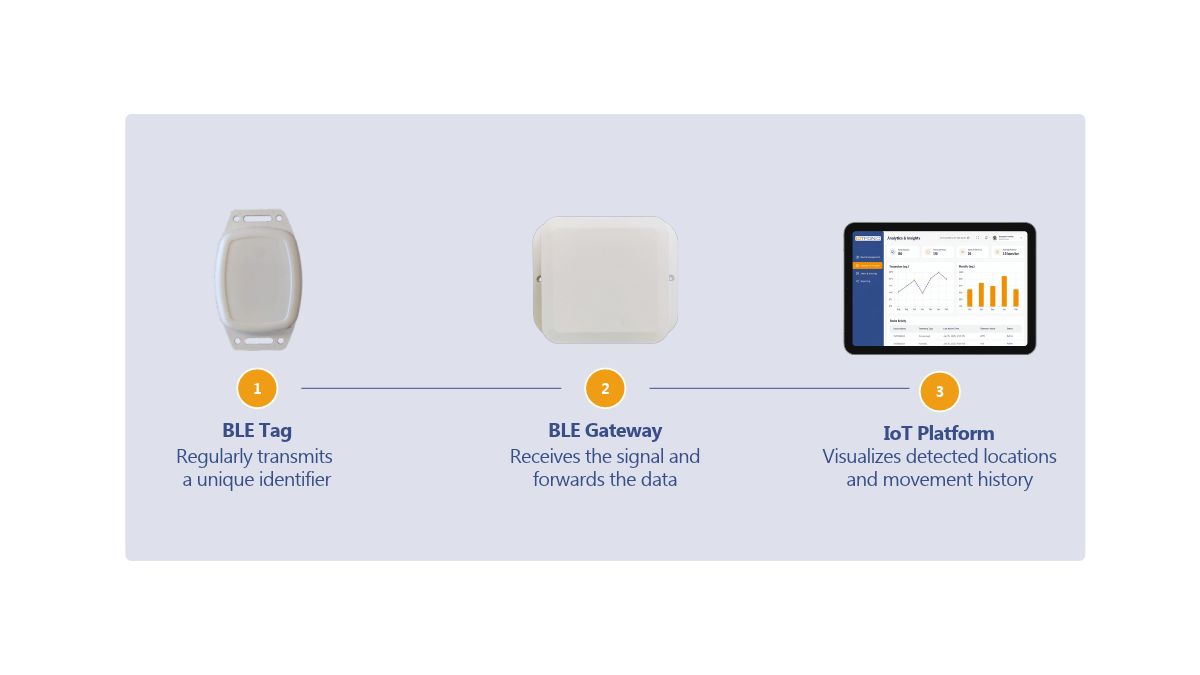
The decisive advantage lies in the low energy consumption. BLE Tags can be operated over long periods of time depending on the device, battery capacity, and transmission interval, without the need for a permanent external power supply.
Unlike classic GPS tracking, no satellite connection is required. This makes the technology particularly suitable for indoor areas where GPS signals are limited or unavailable.
BLE beacons and tags for tool identification
To ensure tools and equipment can be identified automatically, they are fitted with a BLE tag or beacon. The iDTRONIC portfolio offers various solutions for this, including the BB15 Universal Asset BLE Tagand theBE60 Industrial BLE Beacon. Suitable devices can be selected depending on the application environment and the object.
Universal Asset BLE Tag
The BB15 Universal Asset BLE Tag is suitable for labeling various mobile assets. Thanks to its compact design, it can be attached to items such as tool cases or portable equipment.
Industrial BLE Beacon
For industrial applications with higher hardware requirements, the BE 60 Industrial BLE Beacon is available. It can be used for the automated identification of assets within the BLE infrastructure. The tags transmit their ID via Bluetooth. As soon as a gateway receives the signal, the respective asset can be identified in the system.
BLE gateways as a connection to the IoT platform
While the BLE tags transmit the radio signals, gateways handle their detection. The iDTRONIC GT53 BLE PoE Gateway can be installed within the desired building areas and connected via the network infrastructure. Power over Ethernet (PoE) enables both power supply and data connection via a single suitable Ethernet cable.
Depending on the size and structural characteristics of the building, multiple gateways may be required. Together, they form the infrastructure for detecting the BLE tags. As soon as a gateway receives a signal, the relevant information can be forwarded to the IoT platform. There, the data is assigned to the respective asset and made available for further analysis.
Indoor positioning: How accurate is BLE tracking?
A key question when introducing an indoor tracking system is the achievable positioning accuracy. Unlike GPS tracking, BLE-based positioning is based on the radio signals received by the installed gateways. The signal strength, often referred to as RSSI (Received Signal Strength Indicator), can be used as additional information for spatial classification.
If a BLE tag is detected by a specific gateway, it can be inferred that the object is within that reception range. If multiple gateways are installed, additional reception information can be used for position estimation, depending on the system architecture.
The actual accuracy depends on various factors. Metallic surfaces, machinery, and structural obstacles can influence radio propagation. The number and positioning of the gateways also play an important role.
However, for many industrial applications, centimeter-level accuracy is not required at all. Often, it is enough to know whether a tool is located in a specific production hall, workshop, or storage zone. Such zone-based indoor tracking can significantly simplify the search process without the need for high-precision positioning.
Capturing and tracking movement data
In addition to location detection, captured BLE signals can also provide information about changes in location. If an asset is first detected by a gateway in the warehouse and later by a gateway in the production area, a change in the identified location zone can be inferred.
This information can be used for various operational issues. For example, it is possible to track when a tool was last detected in a specific area. Companies can better assess whether an asset might still be in use or if it should be searched for at a different location. Recurring movement patterns can also be of interest, such as when transport carts regularly move between the warehouse and production.
It is important to distinguish between continuous movement tracking and event-based location tracking. BLE tracking primarily documents received radio signals and their timestamps. The movement information that can be derived from this depends on the existing gateway infrastructure and how the data is processed.
Indoor tracking in the iDTRONIC IoT platform
The real added value of an indoor tracking solution arises when the captured information is easily accessible to employees and managers. The iDTRONIC IoT platform serves as a central environment for managing and visualizing connected tracking devices. There, the captured location information can be assigned to the respective assets.
Instead of manually evaluating individual gateways, companies receive a unified overview of their connected assets. The platform makes it possible to view available tracking data centrally. Depending on the specific system configuration, location information and historical data can be used to track changes.
For example, it is possible to check in which building area a tool was last detected. Employees no longer have to rely solely on manual documentation or asking colleagues.
The combination of BLE hardware and the IoT platform thus creates a digital foundation for more efficient tool management.
Typical applications for indoor asset tracking
Tool tracking in production and workshops
Industrial production environments often rely on high-value specialized tools that are shared by various employees or used across different workstations. If a tool is not where it is supposed to be, searching for it creates unnecessary downtime and effort.
By attaching a BLE tag, its presence within the tracking infrastructure can be automatically detected. The last known position or the assigned building area can then be tracked via the IoT platform. Especially for expensive or scarce tools, improved location transparency helps avoid unnecessary replacement purchases.
Asset management in warehouses
Transport carts, mobile equipment, and other assets also frequently change locations within large warehouse areas. With BLE asset tracking , these objects can be digitally tagged and detected within equipped building areas.
This provides a better overview of asset distribution. Employees can search for required equipment more effectively and utilize available resources more efficiently.
Location monitoring of mobile assets
Not every asset is used on a daily basis. Some devices are only needed for specific production steps and are subsequently stored in changing locations. Automated location tracking can be particularly useful for such items.
If a BLE tag is no longer detected by a gateway for an extended period, you can at least determine when the last reception event occurred. Whether the device is outside the reception range or another issue exists may need to be checked separately. Nevertheless, the collected data can help narrow down potential location changes more quickly.
BLE or RFID: Which technology is suitable for tool tracking?
RFID and BLE are not alternatives; they complement each other. Passive RFID transponders do not require a battery and are ideal for detection at fixed points, such as tool issuance, return, or inspection stations. BLE tags transmit independently and show which area an asset is in between these points.
iDTRONIC has been developing RFID hardware for over 20 years and offers BLE tracking from the same source. Those already using RFID can add BLE without replacing their existing system.
Conclusion: Greater transparency for tools and assets
When tools and mobile assets frequently move between different work areas, manual inventory lists are often insufficient for reliably tracking their current location.
Indoor tracking with BLE technology enables automated detection within the installed gateway infrastructure. Companies gain additional information about detected areas and location changes.
With the BLE tags, industrial gateways, and the iDTRONIC IoT platform you can build custom tracking solutions tailored to your specific requirements. This creates the foundation for reducing search times and gaining greater transparency into the operational use of your existing resources.
Do you want to automatically locate tools and equipment in your company? iDTRONIC will assist you in selecting the right BLE hardware and planning a suitable indoor tracking infrastructure.
Test BLE tracking in your own facility.
Our test package for €1,500 plus VAT includes 10 BLE tags, 5 BLE beacons, one BLE PoE gateway, and the starter kit software. This allows you to equip an area and see exactly where your tools are located within just a few days. We will provide support for the placement of the gateway.

Contact us
We are happy to provide personal advice on choosing the right solution.
Your contact person:
Personalized consultation for your RFID project
Luca Mack

Personal consultation for your RFID project
Andreas Jäger - Sales Director

Personal consultation for your IoT project
Luca Mack - Sales IoT