
Products
Smart Access
- RFID
- RFID Cards
- RFID Wristbands
- RFID Key Fobs
- Access Readers & Terminals
- Full-Height Turnstiles
- Tripod Turnstiles
- Security Interlocks
- Swing Gates
- Full-Height Turnstiles
- Electronic Locking Systems
- Locker Locks
Professional RFID
- RFID
- RFID Readers / Antennas
- RFID Embedded
- Mobile Data Collection
- RFID PDAs
- RFID Tablets
- RFID Scanners
Wireless IoT
- Outdoor Solutions
- Asset Tracker
- Temperature Tracker
- Animal Tracker
- Vehicle Tracker
- Indoor Solutions
- Indoor Tracker
- People Tracker
- Software Solutions
- IoT Platform
Applications
Smart Access
Professional RFID
Wireless IoT
Company
About Us
Wireless IoT
Wireless IoT – explained: How companies connect assets, data, and processes
Wireless IoT made simple: Learn how IoT tracking, RTLS, sensors, and asset tracking help companies achieve transparent processes.
Date:
11.09.2026
Reading time:
5 min
Author:

Inhaltsverzeichnis
Machines, vehicles, tools, and containers are constantly generating information in day-to-day business operations. However, companies can only use this data effectively for their processes once it is digitally captured, transmitted, and analyzed. This is exactly where the Internet of Things (IoT) comes in.
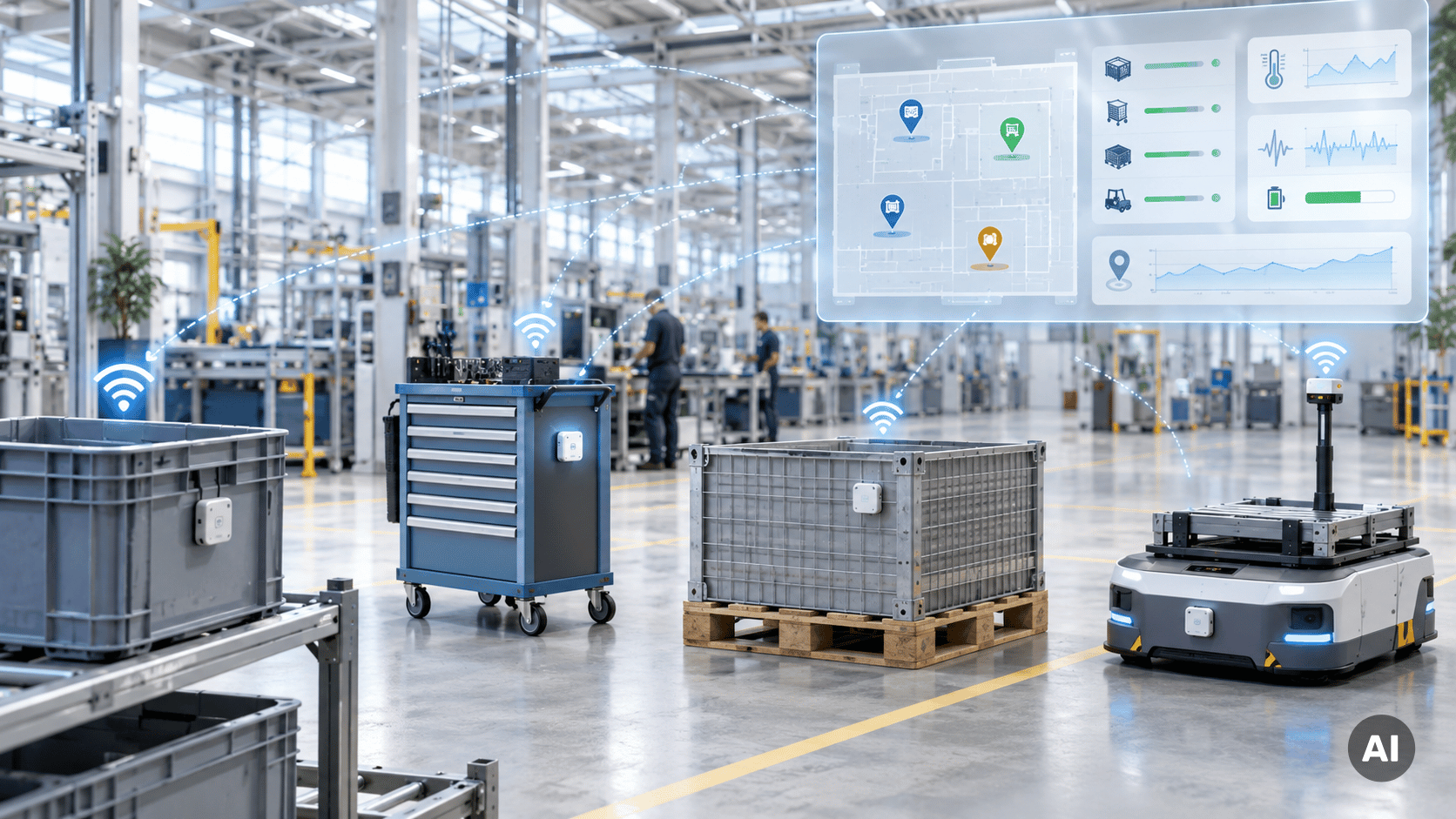
Wireless IoT offers Wireless IoT numerous possibilities, especially for the industrial sector. Connected IoT devices can use sensors to capture data such as locations, movements, or conditions and transmit this information wirelessly to a central platform. This creates transparent processes – from simple IoT tracking to comprehensive industrial IoT applications.
What is Wireless IoT?
IoT stands for Internet of Things, or "Internet of Things." This refers to the networking of physical objects with digital systems.
Wireless IoT involves wireless communication. This is achieved using, for example, trackers, IoT sensors or other IoT devices. They collect information and transmit it directly to a central IoT platform via cellular networks, Bluetooth, LoRa, NTN (satellite), or other wireless technologies. Depending on the application, the following information can be captured:
- Location and movement
- Temperature and humidity
- Operating status
- Vibrations
- Opening and closing of doors or containers
- Run times and usage duration
Especially in Industrial IoT or IIoT , companies can use this to digitally map physical processes and monitor them automatically.
How does Wireless IoT work?
A typical wireless IoT solution consists of several components. First, a tracker or sensor is placed directly on the asset. Depending on the application, positioning is also carried out via GNSS, Bluetooth triangulation, NTN (satellite), or other technologies.
The collected data is then transmitted wirelessly. This can be done using cellular technologies such as LTE-M or NB-IoT . Depending on the infrastructure, communication takes place directly with the cloud or via a local gateway.
The central IoT software then processes the received information. The iDTRONIC IoT platform allows for the centralized display and analysis of locations, movements, and sensor data from various assets. This provides companies with a digital overview of their assets and processes.
Which wireless technologies are used for IoT?
Not every technology is suitable for every application. Key factors include range, energy consumption, accuracy, data volume, and the operating environment.
Bluetooth Low Energy (BLE) is particularly well-suited for identifying and locating assets within buildings. In combination with an RTLS (Real-Time Location System) tools, containers, or equipment can be assigned to specific areas, for example.
LTE-M and NB-IoT on the other hand, enable data transmission via cellular networks. GNSS, often simply referred to as GPS, is primarily used for positioning in outdoor areas. Typical applications include vehicles, machinery, and containers.
In practice, multiple technologies are often combined with one another.
Wireless IoT, RTLS, and Asset Tracking
One of the most important applications of Wireless IoT is asset tracking. Companies often own numerous mobile assets such as tools, machines, transport containers, vehicles, or technical equipment. If these assets are managed manually, it quickly leads to time wasted searching and a lack of transparency.
A asset tracking system can digitize these processes. For indoor tracking , BLE-based trackers, for example, enable the localization of assets within production halls, warehouses, or other buildings.
For mobile assets outside company premises, however, GNSS and cellular technology can be used. A central asset tracking software consolidates the collected data and makes it visible to users. This makes it possible, for example, to track where a container is located, when a vehicle reaches a location, or in which area a specific tool was last located.
More than just tracking positions: monitoring conditions
Wireless IoT can do much more than just track locations. With additional sensors, for example, continuous condition monitoring is possible. Temperature, humidity, movement, or other measured values can be automatically recorded and transmitted.
This makes IIoT also for industrial applications where, in addition to location, the condition of an asset is critical. This allows companies to react more quickly to deviations and document relevant information centrally.
What are the benefits of Wireless IoT for businesses?
The biggest advantage is transparency. Information that was previously only available manually or not at all can now be captured automatically.
Wireless IoT can help companies to:
- locate assets faster,
- reduce search times,
- track locations and movements,
- monitor conditions automatically,
- reduce manual data entry,
- make processes more transparent, and
- make decisions based on real-time data.
For companies, beyond technical functionality, security and data protection also play an important role. Therefore, data transmission, access rights, and integration into existing IT structures should be considered as early as the planning phase of an IoT solution.
Which wireless IoT solution is the right one?
The right solution always depends on the specific application. A tool in a production hall has different requirements than a container crossing multiple countries. In addition to range and accuracy, battery life, wireless technology, sensors, existing infrastructure, and how the data will be used later all play an important role.
This is exactly where iDTRONIC helps companies find the right IoT solution for their application. Together, we evaluate which trackers, sensors, and communication technologies make sense and whether, for example, BLE, LoRa, cellular, or other technologies should be used.
The hardware is complemented by the iDTRONIC IoT platform. It centrally consolidates location and sensor data and provides relevant information in a clear, accessible format. This creates an end-to-end solution, from data collection at the asset to digital analysis.
Conclusion: Wireless IoT creates transparency in physical processes
Wireless IoT connects real-world objects with digital systems. Trackers and sensors capture information, wireless technologies transmit the data, and a central platform makes it usable for businesses.
From BLE indoor tracking and GPS-based asset tracking to industrial condition monitoring, this creates numerous opportunities to make existing processes more transparent and efficient.
The key is not any single technology, but the interaction between hardware, connectivity, and software. iDTRONIC helps companies combine exactly these components into a suitable wireless IoT solution.
Sources:
- Federal Office for Information Security – Wireless IoT
- IBM – Wireless IoT
- GSMA – Mobile IoT: NB-IoT and LTE-M
- Bluetooth SIG – Bluetooth Asset Tracking
- EUSPA – Global Navigation Satellite Systems (GNSS)
- ISO – Real-Time Locating Systems (RTLS)
- ENISA – IoT & Cybersecurity

Contact us
We are happy to provide personal advice on choosing the right solution.
Your contact person:
Personalized consultation for your RFID project
Luca Mack

Personal consultation for your RFID project
Andreas Jäger - Sales Director

Personal consultation for your IoT project
Luca Mack - Sales IoT